

When darkness falls across the Texas landscape and wild hogs emerge from their hiding spots, you need more than courage, you need clarity. The ability to see what others can't, to pierce through the shadows with confidence, separates successful hunters from those who come home empty-handed.
Just as faith illuminates the unseen path forward in life, the right optic technology reveals what's hidden in the darkness of a hog hunt. But which technology gives you that edge? Let's break down thermal versus night vision so you can make the call that's right for your next adventure.
The Darkness Dilemma: Why It Matters
Hog hunting isn't a nine-to-five gig. These destructive creatures are most active when the sun goes down, tearing up farmland and causing thousands of dollars in crop damage across the country. They're smart, they're tough, and they're hidden by the very darkness they use to their advantage.
That's where modern optics come in. Both thermal and night vision give you eyes in the darkness, but they do it in completely different ways, and those differences matter when you're tracking a 300-pound boar through dense brush at midnight.
Thermal: Seeing Heat, Seeing Truth
Thermal imaging doesn't care about light. Instead, it reads heat signatures, displaying the warmth of living creatures against the cooler background of their environment. When a hog's body heat radiates at 102 degrees Fahrenheit while the surrounding grass sits at 65, thermal optics paint that difference in vivid contrast.
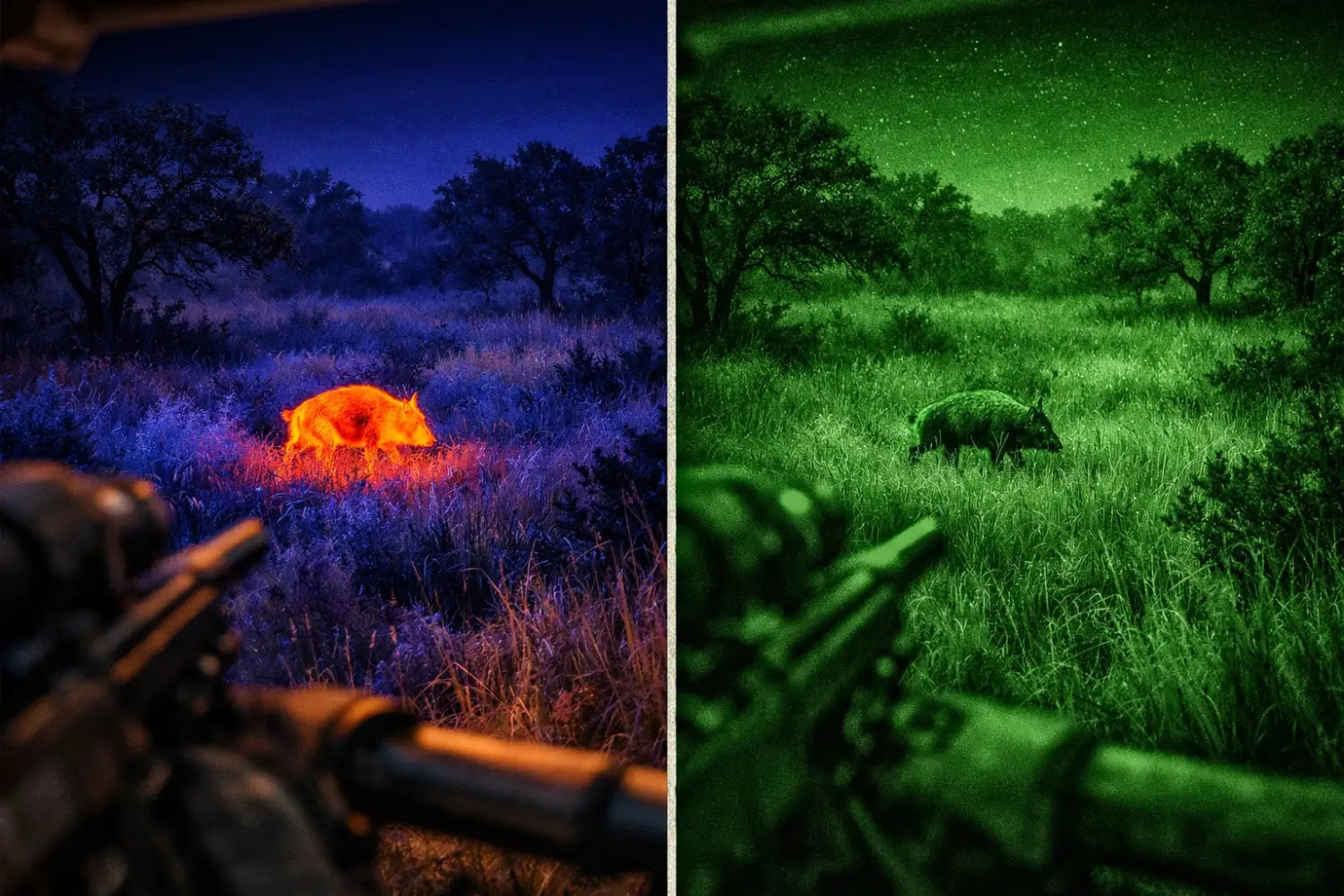
Here's what makes thermal powerful for hog hunting:
Detection through obstacles: Tall grass, fog, thick brush, none of it matters. Thermal reads right through these barriers because it's tracking heat, not reflected light. That hog hiding in dense vegetation? It lights up like a beacon on your thermal scope.
Complete darkness capability: Whether it's a moonless night or high noon, thermal performs consistently. There's no need for ambient light, infrared illuminators, or hoping for clear skies. If there's a temperature difference, thermal sees it.
Range advantage: Quality thermal devices can detect warm bodies at distances exceeding 1,000 yards. You won't be able to identify exactly what you're looking at from that far out, but you'll know something living is there, and you can close the distance with confidence.
Wounded animal recovery: After a shot, thermal makes blood trail tracking dramatically easier. The heat signature from fresh blood and the animal's body heat remain visible even through moderate cover.
In many ways, thermal optics work like spiritual discernment, cutting through distractions and revealing what's truly there beneath the surface. When everything else fades away, the truth remains visible.
Night Vision: Amplifying the Available Light
Night vision takes a different approach. It amplifies existing ambient light, moonlight, starlight, even distant artificial lights, to create a visible green-tinted image of your surroundings. Modern night vision devices can turn what appears to be total darkness to the naked eye into a surprisingly detailed view.
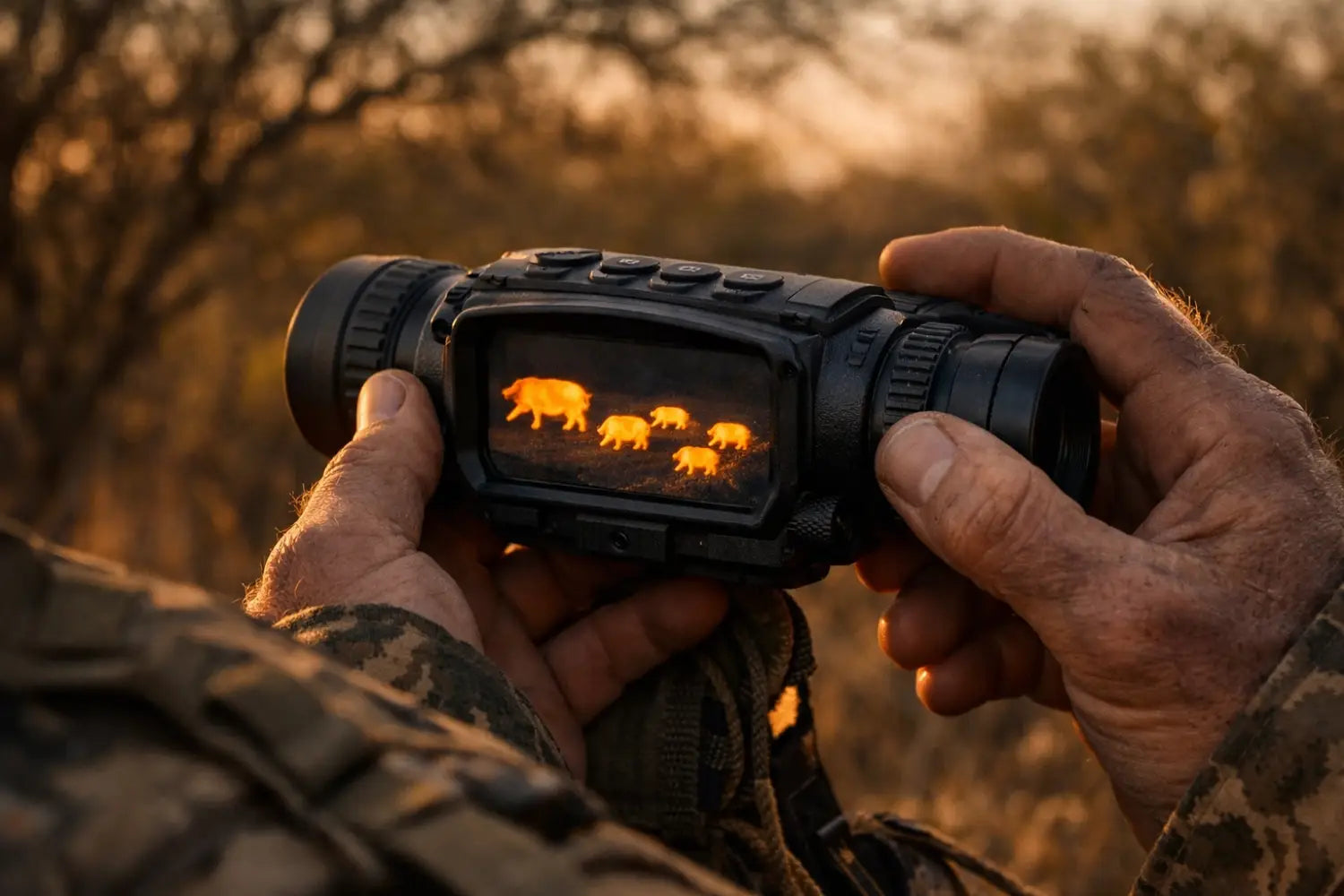
Night vision's strengths include:
Superior detail and identification: When conditions are right, night vision provides incredibly detailed images. You can identify specific animals, see antler points, count hogs in a sounder, and assess shot placement with precision.
Longer battery life: Night vision devices typically outlast thermal units significantly. A full night of hunting rarely drains a quality night vision scope.
Lower entry costs: While high-end night vision rivals thermal in price, entry-level night vision offers more affordable options for hunters just getting started with nighttime optics.
Natural image presentation: The green-tinted image night vision produces feels more intuitive to many hunters. You're seeing an enhanced version of reality rather than interpreting heat signatures.
However, night vision has limitations. It struggles in fog, dense brush, and conditions with minimal ambient light. It requires either adequate moonlight or an infrared illuminator (which can potentially spook animals). And unlike thermal, it can't see through obstacles, if a hog is behind tall grass, you're not spotting it with night vision alone.
Head-to-Head: The Honest Comparison
Let's get practical. Here's how these technologies stack up in real hog hunting scenarios:
In thick brush and tall grass: Thermal wins decisively. Period. If you're hunting South Texas senderos or Arkansas river bottoms where vegetation is dense, thermal's ability to see through obstacles is game-changing.
In open fields with good moonlight: Night vision provides better identification and detail. You'll have an easier time confirming your target and making ethical shots.
In fog or heavy moisture: Thermal handles these conditions far better. Night vision performance degrades significantly when atmospheric moisture interferes with light transmission.
For budget-conscious hunters: Entry-level night vision offers more value initially, but consider that thermal may save you time and increase success rates, ultimately providing better long-term value.
For scanning large areas: Thermal allows faster target acquisition. Warm bodies stand out immediately, letting you cover more ground efficiently.
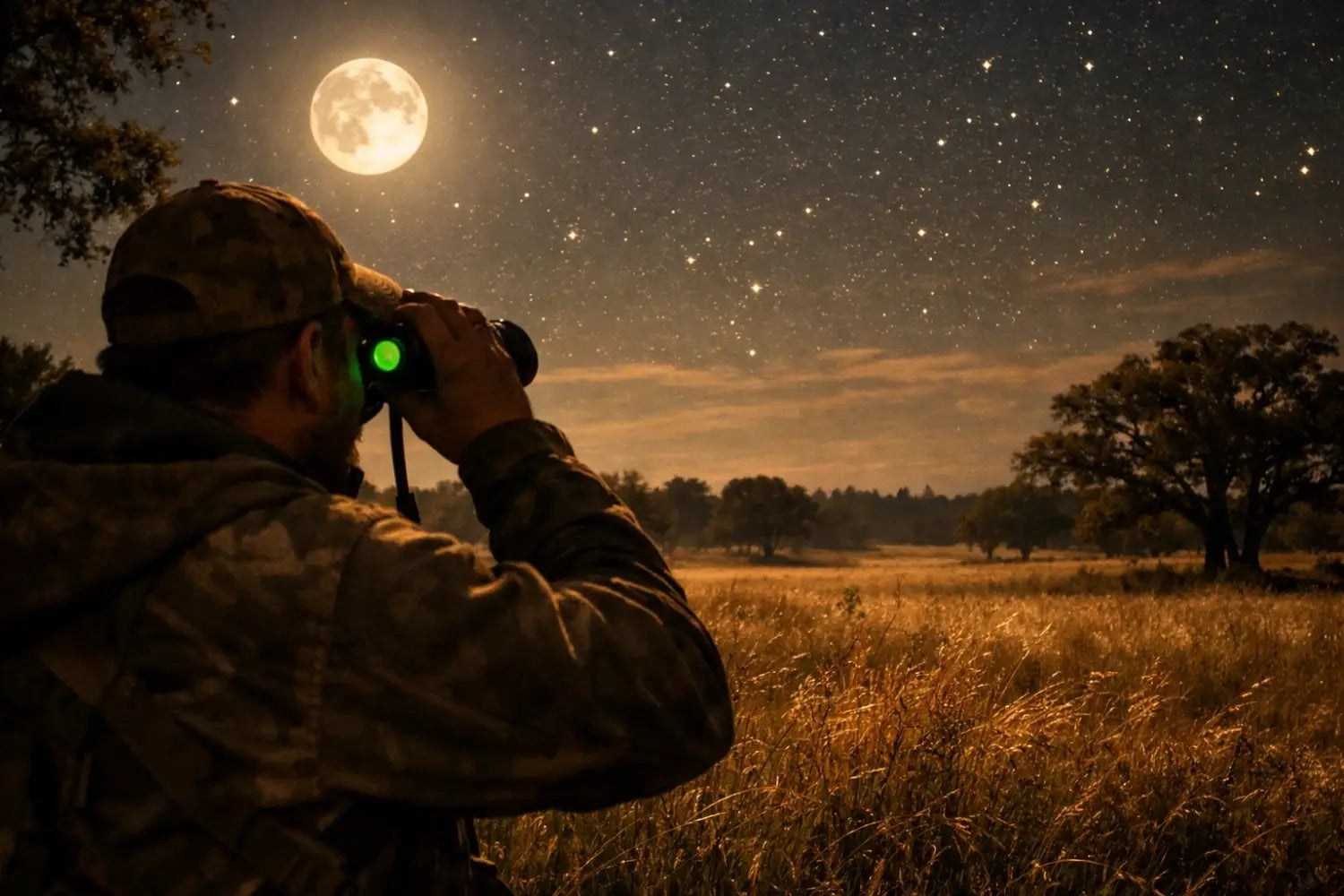
The Hybrid Approach: Using Both Technologies
Here's where experienced hunters have found the sweet spot: use both technologies together, leveraging the strengths of each.
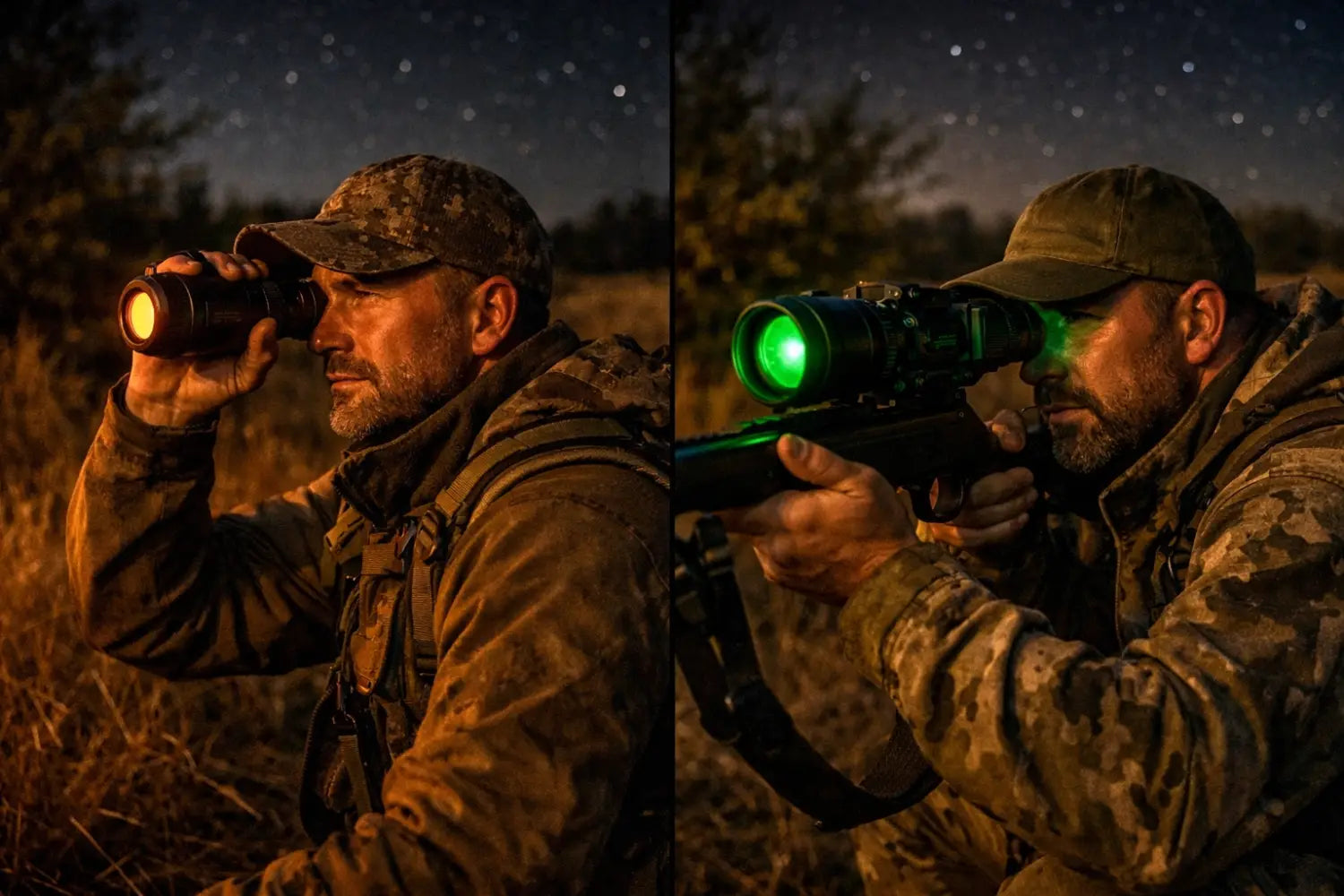
The strategy works like this, scan with thermal to locate hogs across distance and through obstacles. Once you've detected a heat signature, switch to night vision for close-range identification and shot placement. This combination gives you thermal's superior detection capability with night vision's detailed imagery right when you need it most.
Many serious hog hunters run a thermal scanner or handheld alongside a night vision weapon-mounted scope. Others invest in clip-on devices that can be quickly added or removed from traditional optics. Yes, it's an investment, but for those committed to effective hog management, it's an approach that delivers results.
Think of it this way: faith provides the vision to see what's possible, but wisdom guides how we get there. Both matter. Both work together.
Making Your Choice: What's Right for Your Hunt?
Consider your typical hunting conditions. If you're primarily hunting in:
Dense cover, brush country, or areas with frequent fog: Thermal is your answer. The ability to see through obstacles will transform your effectiveness.
Open terrain with relatively clear conditions: Night vision may serve you well, especially if you're working within budget constraints.
Mixed environments where conditions vary: Seriously consider the hybrid approach or prioritize thermal as your primary optic.
Also factor in your hunting frequency and commitment level. Weekend warriors might find night vision sufficient for occasional hunts. But if you're managing land, controlling hog populations seriously, or hunting multiple times monthly, thermal's advantages compound over time.
Seeing Clearly in the Darkness
Whether you choose thermal, night vision, or both, remember this: the right equipment empowers you to hunt more effectively, more ethically, and with greater confidence. Just as walking in faith means seeing beyond what's immediately visible, hunting with modern optics means operating with clarity when others are stumbling in darkness.
The hogs are out there tonight, tearing up cropland and multiplying unchecked. You can wait for perfect conditions, or you can equip yourself to see clearly regardless of circumstances. The choice, as always, is yours to make.
Ready to upgrade your nighttime capabilities? Explore thermal and night vision options at Faith & Freedom Outdoors and step confidently into your next hunt: guided by faith, equipped with freedom, and ready to see what others miss in the darkness. †
Because when you can see clearly, you can act decisively. And that changes everything.